Tag Archives: Spirituality

Pastor Rick’s Study Notes:

1 John 1:1-10

Pastor Rick’s Study Notes:

(PRT) I John 1:1-10

v. 1 What was from the beginning, what we have heard, what we have seen and looked at up close and personally, what we have touched with our hands regarding the Word of Life, v. 2 For that life was made visible and knowable and we have seen it and corroborate and announce to you the life eternal that was with the Father was made known and visible to us. v.3 What we have seen and heard, we announce to you, too. That way you belong in community with us for our very community is with the Father and His Son Jesus Christ. v. 4 And we write these things so our joy might be full to overflowing. v. 5 For the message we have heard from him and we announce to you is this: God is radiant light and there is not one bit of darkness within him. v.6 If we say that we live in community with him, yet choose to live our lives in darkness we are being deceptive and do not live our lives in truth. v. 7 Since then we live in the light just as He is in the light, we live in community with one another, and the blood of God’s Son, Jesus, cleanses us from all sin. v. 8 If we say that we have no sin, we stray from the truth; that truth is no longer inside us. v. 9 If we agree with Him about our sin, he is faithful and just; and because of that, he can forgive our sins and can cleanse us  from all unrighteousness. v. 10 If we say we have not sinned, we make Jesus out to be a liar and his word is no longer inside us.

v. 1 What was from the beginning, what we have heard, what we have seen and looked at up close and personally, what we have touched with our hands regarding the Word of Life,

John is reflecting back to the day when Jesus was near physically. They saw him every day, spoke with him, found themselves enraptured with his teaching and  miracles, and touch him.

Could he be reflecting on Thomas needing to place his fingers in the wounds?

v. 2 For that life was made visible and knowable and we have seen it and corroborate and announce to you the life eternal that was with the Father was made known and visible to us.

Made visible is revealed and seen with the eyes. They touched and saw and heard. He speaks to us, reveals Himself to us, brings His presence to be felt today.

v.3 What we have seen and heard, we announce to you, too. That way you belong in community with us for our very community is with the Father and His Son Jesus Christ.

Jesus revealed himself in order to be revealed. What we see, we talk about.

v. 4 And we write these things so our joy might be full to overflowing.

And here is the reason for this chapter.

v. 5 For the message we have heard from him and we announce to you is this: God is radiant light and there is not one bit of darkness within him.

The word for light is what we get phosphorus from – it radiates from the point within and outward  by the source that creates light.

v.6 If we say that we live in community with him, yet choose to live our lives in darkness we are being deceptive and do not live our lives in truth.

Fellowship  means that we choose to stay in community with Jesus and with each other. We work through things and stay the course and our lives will reflect in a greater way the light and the truth.

v. 7 Since then we live in the light just as He is in the light, we live in community with one another, and the blood of God’s Son, Jesus, cleanses us from all sin.

John connects community and Jesus’ forgiveness. Community reminds us of our stubbornness and pride toward others and we then bring it to God for mercy. Without community, we can more readily stay in our pride and stubbornness.

v. 8 If we say that we have no sin, we stray from the truth; that truth is no longer inside us.

The word for “lie” is the same for straying or being led into a trap; sometimes we are complicit. This is a different word than v. 6 deception. The truth here is that one who has an honest relationship with Jesus, and He has poured His truth into us, we would never say “I’m good and righteous on my own.”

v. 9 If we agree with Him about our sin, he is faithful and just; and because of that, he can forgive our sins and can cleanse us  from all unrighteousness.

Confess here means we agree with the Father about what we have done, that it is wrong, and needs His mercy. And because he is faithful to His promises and he is just in the manner in which he handles our cry for forgiveness, he can forgive and he can cleanse. The “can” means that He is there in the moment of possibility we need forgiveness and in the moment of confession and agreement, can forgive.

v. 10 If we say we have not sinned, we make Jesus out to be a liar and his word is no longer inside us.

Again, the truth here is, our choice to have a deepening and honest relationship with Jesus would never allow us to “not agree” with Him about our need for his mercy. Vv. 8 and 10 nudge us into an honest treatment of v. 9, the Restoration Promise. We are honest when we sin, and we are open to Him to show us where we still have shame and guilt, and we agree with Him. And because of the fact that He is faithful and just, we can be forgiven.

Pastor Rick’s Study Notes & Small Group Questions: John 3:16-21

Pastor Rick’s Study Notes:

(PRT) John 3:16-21

v. 16 For God loved the world so much that He gave His one and only Son so that everyone who puts their faith in Him should not perish but instead have eternal life.

v. 17 After all, God did not send His Son into the world to condemn the world but for the express purpose that the world could be saved through Him.

v. 18 Whoever puts their faith in Him is no longer under judgment; but whoever has not put their faith in Him already lives under judgment for this very reason: they have not put their faith in the one and only Son of God.

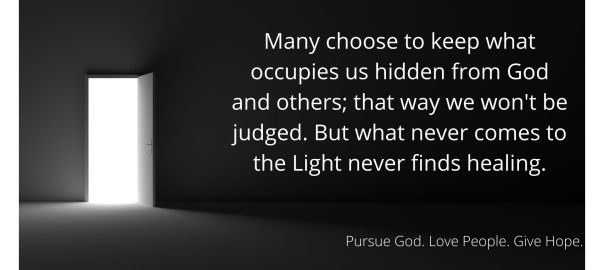
v. 19 This, then, is the judgment: The Light has come into the world, but people more willingly loved the darkness instead of the light for they were occupied with wickedness.

v. 20 For each person continually practicing evil despises the light and does not step into the light; otherwise, what they are occupied with is uncovered.

v. 21 But, everyone who keeps doing what is true steps into the light; that way, the deeds they are occupied with might be revealed for what they are, by the hand of  God.

v. 16 For God loved the world so much that He gave His one and only Son so that everyone who puts their faith in Him should not perish but instead have eternal life.

Some commentators feel that, beginning with this sentence, Jesus quits talking and John begins his comments on the meeting. There is no indication that Jesus has left off; he knows who he is and what he came to accomplish. Jesus is giving us the “establishing shot” of the Good News of the Kingdom. It does read easier as a Johannine aside.

John’s use of agape is his trademark word for what God the Father is doing through Jesus. He loves. That he loves the world, that is all the people of the earth, is news to the religious leaders who assume they are the only lovable ones. Do you ever think of yourself as “loveable?” God. Loves. You. Romans 8:32.

This passage captures the intimacy of the Triune God, the essence of God’s plan, the depth of his love, the reach of his provision, the power of His redemption and the severity of the enemy’s hold on man.

For God – 1 Thess 5:23, So loved – Romans 5:8, The world – 2 Cor 5:19, He gave – dozens of times in John’s Gospel, “the father sent me,” His one and only Son – Hebrews 1:2, whoever – Romans 5:6, believes in Him – 1 John 5:13, not perish – 2 Peter 3:9, have life – John 10:10, John 1:12.

v. 17 After all, God did not send His Son into the world to condemn the world but for the express purpose that the world could be saved through Him.

Every nation; not just the Jewish people. He came to revolutionize the world, one nation, one tribe, one tongue at a time.

While Jesus’ coming lays out a clear choice for salvation and restoration to all people, and those who refuse or ignore will be separated and judged, it is not for this judgment that Jesus came; it is for salvation, for love, for relationship for a lifetime.

Condemn may be better as judge, in order to fit the rest of Jesus’ argument. He didn’t come to bring judgment; he came to save.

God sent, as it God, the one who enters at the demand of another a new place of people. Apostello – God the Father sends (apostello) Jesus on mission.

v. 18 Whoever puts their faith in Him is not under judgment; but whoever has not put their faith in Him already lives under judgment for this very reason: they have not put their faith in the one and only Son of God.

An interesting aside: the dark isn’t bad when it conceals good deeds from the eyes of evil people who might pursue for harm. Keeping actions in the dark when those very actions might, if seen, bring harm; that is a time when we ask God to make them obscure.

This verse is a dividing line. Those who have light poured in, who have life; or those who keep their pursuits in the darn,

v. 19 This, then, is the judgment: The Light has come into the world, but people more willingly loved the darkness instead of the light for they were occupied with wickedness.

Occupied is the same word for works. Occupied might fit better since this verse is discussing what we keep on working on. If my works are the continual focus of darkness without ever seeking the light, then judgment is certain.

They are enamored with the light and the values it brings; but they hate the Light, the personality of God’s own Son. Could it be that those in darkness want what the light brings but only if they can manufacture it themselves? John 5:35 They loved, that is, they were enamored with, the light for a time, but rejected it in the end.

v. 20 For each person continually practicing evil despises the light and does not step into the light; otherwise, what they are occupied with is uncovered.

Evil in verse 19 is a harsher word than here in verse 20. Here, evil means fruitless or meaningless. If we occupy our lives with things worthless and that have no substance, we are despising light and hope to keep our practices under cover.

“practicing evil” as in the works of the individual that ignore God’s ways and truth.

v. 21 But, everyone who keeps doing what is true steps into the light; that way, the deeds they are occupied with might be revealed for what they are, by the hand of  God.

The word for doing in the context of evil and good is different. One means to keep practicing evil; the other could mean pursuing good.  “Do truth” means that our pursuits are based on the truth of God’s Word morally and of value to the Kingdom.

The deeds are what aligns with God’s ways and are empowered by his hand. When we do good in His name, He empowers it beyond our own capacities.

In the film industry, the establishing shot is the context builder. It establishes the person in context to location and tone as well as the time period and feel of the coming shots. They give sweeping, wide focus to what the main character will face.

Your life and mine is God’s writing his story into us and through us. Our testimony. Our relationship is in context with the Gospel of the Kingdom, the ultimate story.

Small Group Discussion:

  1. Do you have a favorite movie character that, if you could, you would become? Why?
  2. John 3:16 is the possibly the most famous verse in the Bible. When did you first see it? When did you first discover what it means to you? Or are you still trying to find out about it?
  3. Jesus gives everyone the same starting point in life according to v. 18. What does this say?
  4. What is God’s solution in these verses for us to know Him?
  5. Do you ever think of yourself as “loveable?” In light of John 3:16, how does God see you?
  6. What is going on in your life that you need God’s touch or provision for?

Pastor Rick’s Study Notes: Matthew 5:17-20

Pastor Rick’s Study Notes:

PRT Matthew 5:17-20

v. 17 Don’t even consider that I have come to destroy the Law or the Prophets; I came not to overthrow and dismiss them but to satisfy and fulfill them.

v. 18 For I tell you this very truth: until heaven and earth come to an end, neither the smallest letter nor the tiniest accent point will disappear until all these things will happen.

v. 19 for this reason, anyone breaks even the smallest of these commandments or teaches others to do the same, will be the smallest in the Kingdom of Heaven. But here’s the one who will be great in the Kingdom of Heaven: everyone who does what it says and teaches others to do the same.

v. 20 For I tell you that, unless your right actions and right relationship with God extends beyond the standards of the legal experts and Pharisees, you won’t even enter the doors of heaven.

Study Notes:

v. 17 Don’t even consider that I have come to destroy the Law or the Prophets; I came not to overthrow and dismiss them but to satisfy and fulfill them.

Jesus is answering an unspoken question here (or perhaps he heard the rumblings of this statement about tearing down the law and prophets – it later became one of the big accusations. He didn’t destroy (he wrote them!) The word is to break down, dissolve, dismiss, abolish. He came to fulfill the prophets and satisfy the law.

This word destroy is a word picture of someone taking down a tabernacle or tent into pieces. He came to fulfill, that is fill to the fullest, the Law and Prophets.

Light plays a huge role in demonstrating the effect of the Kingdom on people, churches, cultures, generations, etc. We are brought into the light, become the light of the world, and are indwelt by the Spirit of Jesus, the Light of the world.

Ephesians 4 “we were in darkness and now we walk as children of light.”

Philippians 2:15 “you shine as lights to the world.”

1 Peter 2 “we are called out of darkness and into His wonderful light.”

Read this in context with v. 15-16 – what we do is in the light, not to show us to the world, but to show Jesus to the world. Matthew says the light is on the stand where everyone in the house can see the light. Luke says the light is on the stand so that everyone who enters into the house can see. He satisfies the reason people grasp for religion and rules. Jesus completes the prophetic.

v. 18 For I tell you this very truth: until heaven and earth come to an end, neither the smallest letter nor the tiniest accent point will disappear until all these things will happen.

The smallest letter of the Hebrew language is the “yod” – no bigger than an apostrophe. The accent point in Greek is the little marking that might distinguish letter and pronunciations. These accents were not widely used in the marketplace since most wrote in Uncial; and after all, it was their language.

Here, the word is not everlasting but sufficient until heaven and earth disappear. At that point, we will as Paul says, “know in full.” Until God brings it all to the culmination, not even an accent point will be canceled.

v. 19 for this reason, anyone breaks even the smallest of these commandments or teaches others to do the same, will be the smallest in the Kingdom of Heaven. But here’s the one who will be great in the Kingdom of Heaven: everyone who does what it says and teaches others to do the same.

Remember that the legal experts and teachers had set the laws in major and minor categories – greater laws and lesser laws with corresponding ramifications. Some says 613, but these are what Moses said to do or not do. The “for all time” laws are the big ten.

The “least” in the kingdom is a word that can mean littlest or smallest; the person who chooses to live contrary to God’s parameters and/or takes others in the same direction chooses a “small” life here, and the “smallest” life in eternity.

It’s choosing to live in the light. Luke adds some insight here; our acts give light to the world and cause the lost to bring glory to God. Our eyes are our light in Jesus’ parables; and we let light in by what we choose to give witness to; or we let “dark” into our eyes by what we feed on.

The big question on everyone’s mind, then, if the Pharisees and the teachers of the law aren’t in, who will be? Nobody wants to be small; so who will be great? Jesus answers: you who do and teach (demonstration, proclamation.) the Pharisees (Matthew 23:3) taught but clearly didn’t do. That’s why he said the next sentence.

v. 20 For I tell you that, unless your right actions and right relationship with God extends beyond the standards of the legal experts and Pharisees, you won’t even enter the doors of heaven.

These are the comments that endeared Jesus to the people and drew the ire of the temple leaders. This would also fly in the face of “common wisdom” that the Pharisees and legal experts were the examples to follow; Jesus says it’s the exact opposite. It’s like the lovers of the law were approaching heaven, but couldn’t see what stopped them (unforgiven sin – they needed a Savior.)

  1. Have you ever been in a place that was completely, utterly, dark? How did it make you feel?
  2. Do you have a favorite Bible verse? What is it? Why is it so meaningful to you?
  3. How do you “let light in” to your life through using the Bible? What practices do you do now? What do you need to begin practicing?
  4. What can you do the avoid places that make your life smaller and darker?
  5. What kinds of “beautiful deeds” do you like doing for others to help them experience the love of the Savior?
  6. How can others help you through prayer and encouragement?

Pastor Rick’s Study Notes:

Pastor Rick’s Study Notes: Haggai Overview and the Key Passage of the Prophecy.

Haggai Chapter 1

  • This prophet speaks into the early leaders who returned from captivity with the People of God, Zerubbabel and Joshua. These two leaders came to Israel with 40K refugees to rebuilt the Temple and begin to restore Israel.
  • And Haggai preached to them and encouraged them to follow God, trust in His care and power, and continue the work. He may have preached all the way into the days of Ezra when he returned to Israel – at least Ezra recorded the impact Haggai had on the rebuilding of the Temple.

The Big Issue: The work on the house of worship stalled for more than a decade, but the people of God were convicted and drawn back to His purposes through Haggai. V.12-15 is the turnaround passage.

  • Haggai is a book of questions? Do you build your house before you build your God a place of worship? Why the drought? Who can compare the former house to the latter one? Is there anything left in the barn?

Haggai Chapter 2

This prophet saw the big picture.

  • The People of God were returning to Israel to rebuild the Temple, restore the city and nation, all to accomplish the mission – to be a light to the nations and a place of worship for all people (2:5)
  • All that God wants from the nations will come to Jerusalem and it will be a place filled with His glory and a house of peace.

(PRT) Haggai 1:12-15

v. 12 They all obeyed the voice of the Lord their God: Shealtiel’s son Zerubbabel, Jehozadak’s son Joshua the High Priest, along with all the remnant, and they heeded the words of the prophet Haggai that the Lord their God had sent.  And the people honored and reverenced the Lord.

v. 13 Then Haggai, the messenger of the Lord spoke the Good News of the Lord, and said to the people: “I am with you,” says the Lord.

v. 14 And the Lord awakened the spirit of Shealtiel’s son, Zerubbabel, Judah’s governor and the spirit of Jehozadak’s son, Joshua the high priest and collectively the spirit of the remnant of the people. Then they came together to accomplish the work on the house of their God, the Lord of hosts.

v. 15 On the 24th day of the sixth month of the second year of Darius’ reign.

Study Notes:

v. 12 They all obeyed the voice of the Lord their God: Shealtiel’s son Zerubbabel, Jehozadak’s son Joshua the High Priest, along with all the remnant, and they heeded the words of the prophet Haggai that the Lord their God had sent.  And the people honored and reverenced the Lord.

The opposition they faced was discouragement, change, want, and the enemy.

  • And because of this discouragement, the people had simply become indifferent, ambivalent to the things of God.
  • They went through the motions because they had built the altar and the priests could make their sacrifices; but the fire of that altar hadn’t consumed them to the point that all they were and all they desired were the Lord’s.
    • What do you do when discouragement threatens your faith in action?
    • What do you do when defeat seems to characterize your life more than victory?
    • What do you do when disappointments overshadow and rob you of the joy you’ve known in the Lord?

v. 13 Then Haggai, the messenger of the Lord spoke the Good News of the Lord, and said to the people: “I am with you,” says the Lord.

  • This is the only time the word the New Testament translated as The Message, The Good News, or sometimes, The Messenger, is used in the OT.
  • It is Good News that God is with us.
  • In fact, The first part is the Lord’s Name – the great “I AM.” And the second part echoes Isaiah’s prophecy concerning Jesus – “His name shall be called Immanuel, God with us.”

v. 14 And the Lord awakened the spirit of Shealtiel’s son, Zerubbabel, Judah’s governor and the spirit of Jehozadak’s son, Joshua the high priest and collectively the spirit of the remnant of the people. Then they came together to accomplish the work on the house of their God, the Lord of hosts.

And the fire was reignited, first one person (the Governor), then another (the Priest) – then he awakened the whole remnant and their culture was changed.

v. 15 On the 24th day of the sixth month of the second year of Darius’ reign.

And all this happened in three months. Haggai hung around and taught and shows up in Ezra. But his faithfulness to speak to the authority and encourage the people changed their direction.

Pastor Rick’s Study Notes: Nehemiah 8:1-12

Chapter 1

After at least three starts on the wall under Zerubbabel and Ezra, Nehemiah gets permission to take the immigrants and travel to Jerusalem.

Chapter 2

Prayer for grace in the moment- Nehemiah breathed a powerful prayer:

Chapter 3

When the building began, it was an all-hands operation. Each section was built by a different group and it is a great example of how diverse the work of the Kingdom can be: 1) religious leaders and their people, 2) families and extended families, 3) a group of sons, 4) a group of daughters, 5) different trade groups like perfume-makers, goldsmiths, 6) groups of neighbors, 7) politicians, 8) worshipers, 9) merchants and marketers.

Chapter 4 & 5

Don’t fear; keep building. To the vigilant, to the multi-tasker is the victory.

Chapter 6 and 7

Discourage their hearts, confuse their minds, weaken their hands.

52 Day project to complete the wall.

Chapter 8

Ezra read and the people were enthralled.

What happened at the first Water Gate.

Men and women, later sons and daughters – all who could get it, got it.

Mic drop in Jerusalem.

Revival in the city.

v. 11 Key verse.

(PRT – Nehemiah 8:1-12)

7:73 And so the priests, Levites, doorkeepers, singers, and a remnant of the people, the temple servants, and all Israel lived in their cities. And on the first day of the seventh month (around October) the children of Israel lived were living in their hometowns.

8:1 And the people came together in unity with a purpose in the streets in front of the Water Gate and the pleaded with Ezra the scribe to bring out Moses’ Book of the Law that the Lord has commissioned and given to Israel.

Ezra was part historian and annalist, part accountant, part teacher, and part priest. The word scribe has a complicated meaning. He kept up with the people, the story God was working out in them, and how His Word related to their story.

He had been in Jerusalem since the beginning of the return from captivity. He’d weathered the accusers, deceivers, and obstructors from the outside; and he’d encouraged the complacent, greedy, and selfish from the inside.

  • Nehemiah 1 God breaks his heart for his city and God’s people, they are just a remnant.
  • In Nehemiah 7 Only a few but God brings them together.
  • In Nehemiah 8 all who could came together. But God was still not done with gathering His people.

8:2 Then Ezra brought the law out on the first day of the seventh month (around October) to the gathering of men, women, and all who could grasp its meaning.

This day is the beginning of the celebration of Tabernacles and the Day of Atonement. The wall is finished; the people takes a few weeks to resettle; and they return to worship.

God’s Word is for all; God’s Spirit comes on all; even the children and anyone who could comprehend.

8:3 And he read from the book right there on the street before the Water Gate to the men, women, and all the people from daybreak to noon and those who could grasp its meaning were focused on the Book of the Law.

The word for “all” is used ten times in these 12 verses. The gathering has gone from a remnant of faithful, a few who would not give up, to all who lived there. But God was not done; the gathering of His people continued as more and more returned to Jerusalem. The same today: God’s people are still being gathered.

8:4 And Ezra stood on the wooden stage they had made for this very purpose. Standing to his right were: Mattithiah, Shema, Anaiah, Urijah, Hilkiah, and Maaseiah. And standing to his left were Pedaiah, Mishael, Malchiah, Hashum, Hashbadana, Zechariah, and Meshullam.

These were the qualified leaders and teachers from among the Levites. The significance of six on one side and seven on the other is likely scribal – someone got moved or left out.

8:5 They stood above the people so all could see them, and when Ezra opened the Book from the stage, they all stood up.

The people prepared for God’s servants to be heard. They built a stage. At dawn at the Water Gate, the sun would be streaming down on the faces of the listeners. The sight for those on the platform must have been awe-inspiring.

8:6 And Ezra kneeled and worshiped before the Lord, the Great God; and the people responded “Amen! Amen!” They lifted their hands and they bowed down with faces to the ground all while they worshiped the Lord.

And his response at the sight was humility. He was down on his face worshiping. The people did likewise, not because they wanted to do what Ezra did, but because they were overcome by God’s presence. They heard truth, they worshiped, they lifted hands, they shouted, and they fell down before God’s presence.

8:7-8 Also, Jeshuah, Bani, Sheribiah, Jamin, Akkub, Shabbethai, Hodijah, Maaseiah, Kelita, Azariah, Jozabad, Henan, Pelaiah, and all the Levites helped the people understand the meaning of the Law. And the people stood still as they read from the Book of God’s Law; and they gave clear insight to help the people comprehend what they were reading.

“Clear insight” could also mean that they “translated” to those who had been in foreign lands.

8:9 Then Nehemiah the governor and Ezra the priest and scribe made sure that the Levites taught the all the people: “This day is holy. This is from the Lord your God so do not grieve or cry, for all the people wept as they listened to the Words of the Law.”

The people were so loudly grieving and overcome by tears that the leaders were concerned the would miss the most important element of worship: joy.

8:10 And he said to them: “Go, eat and drink richly, and share your abundance with those who are without. For this day is holy to our Lord; don’t be sorrowful, because the joy of the Lord is your strength.

Our joy is our strong place of refuge. When we are tempted, run to the refuge. When we are accused, run to the refuge. When we face dark times, run to the refuge and rejoice that Jesus is near and loves us.

8:11 So the Levites soothed all the people: “Be at peace and don’t be sorrowful, for this day is holy.

When God’s Spirit falls in awakening power, convicting and persuading His people to know and seek Him above all, it changes His people forever. Nothing like it; no experience compares.

8:12 And all the people left there to eat and drink, and to share from their abundance, and to celebrate gladly, for they understood the words that were taught to them.

This was the day before Tabernacles begins and celebration is in order. And celebrate, they did! It was an eight day worship service.