Tag Archives: forgiveness

Acts 2:34-41 Pastor Rick’s Study Notes and Small Group Questions

Pastor Rick’s Study Notes:

Acts 2:34-41

(PRT)

vv. 34-35 For David did not rise again into the heavens, but he himself says: “The Lord said to my Lord, ‘Sit at my right hand at the place of authority and honor, even while I put your enemies under your feet like a footstool.’ v. 36 Therefore, all Israel, you can know with all confidence that God has made this same Jesus whom you crucified, both Lord and Messiah. v. 37 And grasping all of this, the crowds were pierced to the heart and called out to Peter and the rest of the Apostles: “Brothers, what do we have to do?” vv. 38-39 Peter then urged them: “Repent and be baptized, each of you, in the name of Jesus Christ, for your sins’ forgiveness, and you will receive the gift of the Holy Spirit. For this promise is to you, to your children, and to everyone who is far away, as many as our Lord and God will call.” v. 40 And he warned them with many more words and encouraged them: “Choose to be saved from this warped and deceitful generation!” v. 41  Then those who accepted his words were baptized and around 3000 were added to their number that day.

Study Notes:

vv. 34-35 For David did not rise again into the heavens, but he himself says: “The Lord said to my Lord, ‘Sit at my right hand at the place of authority and honor, even while I put your enemies under your feet like a footstool.’

David didn’t ascend, or rise, into the heavens. In other words, he was buried just like all people.

This refers back to the other Psalm reference and the resurrection. If David, the King most revered, didn’t rise untainted by corruption, who will fulfil this prophecy? Look for the one who rises to the heavens without decay. That would be Jesus.

The main point Peter makes from this verse is that David, though a great King and revered, was not Lord. Rather, the Lord is in the place of authority and honor.

The enemies are those hostile to the Lord’s plans, the adversarial ones in opposition to His will.

He doesn’t take the place of authority and honor after all the hostiles are taken down; He is there now as the Kingdom of God comes in fulness.

During these days, if a conquering king was present, the enemies (or at least the opposing ruler) would kneel and the conqueror would set his foot on the necks of the vanquished. This signified total defeat and allegiance in servitude.

Jesus the King is conquering those at odds with him by His love and grace; and those hostile who never turn are being set in their places. The Kingdom is casting down the works of the enemy.

v. 36 Therefore, all Israel, you can know with all confidence that God has made this same Jesus whom you crucified both Lord and Messiah.

Jesus the miracle worker has now sent the Promise of the Father, the Holy Spirit (Joel), He has conquered death (David’s Psalm) and He sits in the place of authority and honor in the heavens (David’s Psalm). Based on this Biblical account from the OT, the knowledge they have of Jesus walking among them, and the present Holy Spirit, it can only mean one thing: Jesus is Lord and Messiah. And the Father has made this so!

The word for all confidence means a certainty. The word for “can know” is one that means with head and heart.

The Greek phrase means to slip or trip. You can know without a slip or trip that God has done this.

He calls on all Jews to know this since they are the recipients of the prophecies, they can know with confidence that Jesus is Lord and Messiah.

Juxtapose this cold-hearted response to the Messiah with Luke 19:41 when Jesus looks over Jerusalem and weeps for them.

v. 37 And grasping all of this, the crowds were pierced to the heart and called out to Peter and the rest of the Apostles: “Brothers, what do we have to do?”

The verb means “what, in light of all you’ve said and all we have done to Jesus, must we do?” God’s Spirit brings conviction to the heart for repentance and redemption. This is what happens when the Good News is shared with confident passion to people who get it. They get right with God.

The hearers were moved to remorse at their actions and ignorance. Now they knew. And we know that the Holy Spirit is active in making this known.

vv. 38-39 Peter then urged them: “Repent and be baptized, each of you, in the name of Jesus Christ, for your sins’ forgiveness, and you will receive the gift of the Holy Spirit. For this promise is to you, to your children, and to everyone who is far away, as many as our Lord and God will call.”

If you are uncertain what the crowd meant by “what do we do” Peter makes it clear: acknowledge you are culpable, you’ve failed God and turn from a life that does so. Announce it to the world through baptism, but not like John’s – in the Name. You’ll get the Holy Spirit, you’ll be forgiven, and the promise will be realized in Him.

Peter is speaking to “everyone” and at the same time “each one.” This is a people movement of all, one at a time, who repent, goes to the waters, receives the Spirit.

I can’t see that there is a progression of the order of actions here, since at the end, he asserts that the promise is to whoever God calls. From this, I see acknowledging Jesus as both Lord and Messiah, repentance, and a public declaration all fully together as our response to the Good News;  the Father’s response is forgiveness, relationship with the Father, and the gift of the Holy Spirit.

Luke has Jesus instructing the disciples to bear witness and call people to repentance so they can be forgiven (Luke 24). Matthew’s account of the Great Commission includes baptism (Mt. 28:19). Even in Peter’s first sermon, the nations are include – “all who are far off”.

All Israel, you know the prophecies and you can connect it all together; but to all the world, the invitation is this: turn away from a life without God to the Savior Jesus, show the world your new allegiance, and be filled with the Spirit of God.

v. 40 And he warned them with many more words and encouraged them: “Choose to be saved from this warped and deceitful generation!”

The word could mean teachings and instead of warn, declare or speak. Warn fits what come right before and right after this word.  What kind of age, season, nation or generation are they in? One that is warped in thinking and perverse in action. This generation was not thinking or talking straight and their actions were deviant and corrupt. What is our response to such? Find the place of safety and be delivered to a secure place.

“Save yourself by being saved” is the intensity; in other words, You have before you how to be saved, choose to be saved.

The age they lived in was heading toward destruction and Jesus stands in the gap.

v. 41  Then those who accepted his words were baptized and around 3000 were added to their number that day.

We always say 3000, but this affirms that they didn’t get an exact count. More or less. It was 3000-ish. Not worth the quibbling, but they had more on their minds than click off the people counter. There were now 3120 (or 3500, if you go by the 500 on the hillside); and they needed to be disciples in the ways of Jesus.

While many say numbers don’t matter – it’s the quality, not the quantity –  Acts shows a different perspective. Both are important. Here is the quantitative; vv. 42-47 is the qualitative. And in the signs and wonders of the Pentecost outpouring and Joel’s passage, we have the corroborative. Numbers, character, and evidence all point to the Gospel’s power.

Were they all baptized that day? There were pools and water features around the city so it could be possible. Not all of the 3000 stayed after the Pentecost feast; but they left saved and  baptized to live for Christ in their home town under the leadership of God’ Promised Spirit.

Small Group Questions:

Acts 2:34-41

  1. Who gives best directions in your family? Or how are you at giving directions?
  2. If you were in the crowd when Peter said v. 36 how you have felt? How does this verse apply to you since you were in Jerusalem calling for Jesus’ crucifixion.
  3. Of the three questions – Who’s in Charge of my life? Where did I go wrong? How do I get back on track? – which is most relevant to your life today? Why?
  4. How can we pray for you tonight?

Pastor Rick’s Study Notes on Isaiah 53:1-6 and Small Group Questions

Summary Notes on Isaiah. This passage is quoted in more than one place in the New Testament, John 12:37-38 for instance. In these six verses, Isaiah identifies who Jesus is, how He was received, what he came to do, and who responded favorably.

Pastor Rick’s Study Notes:

Isaiah 53:1-6 (PRT)

v. 1 Who has placed trust in our announcement? To whom has the Lord revealed His strength?      

v. 2 For he shall sprout like a tender sapling before him and a root out of the parched earth; and when we see Him, we are not drawn to him because of  his appearance and good looks.

v. 3 He is despised and discarded, a man of sorrows on first-name basis with grief. We turned our faces away from Him; he was dishonored and counted as nothing.

v. 4 Certainly, he has lifted our sicknesses and carried our sorrows away; we considered Him overwhelmed, beaten, and humbled by God.

v. 5 But he was wounded for rebellion and broken for our sinfulness; for our peace, our punishment was on him and by his stripes and bruising we are healed.

v. 6 All of us have wandered away like sheep; we each have turned away to our own way; and the Lord has laid on Him all our sinfulness.

Study Notes:

v. 1 Who has placed trust in our announcement? To whom has the Lord revealed His strength?

Who believes the report we give? The assumption is that some have believed. Discovered as in revealed or unveiled. The arm of the Lord. Who is the “hearer” in these verses? The nations? The people of God?  John 12:37-38 is the NT referencing of this passage. If the people of God, they are lamenting their blindness. They didn’t see Him when he came.

v. 2 For he shall sprout like a tender sapling before him and a root out of the parched earth; and when we see Him, we are not drawn to him because of  his appearance and good looks.

His handsome or winsome appearance are not what will draw us to him. The idea is that he will look like he’s gone through the trials of the desert.

He is a Savior unlike any would imagine. Instead of the “kingly” image of David, the Savior came in common form, with the weaknesses humanity has, breaking into the world through the pains of birth.

The lament of  the people of God is matched by the Gentiles seeing something never before imagined; a Savior who knows us and has the power to save.

The parched earth is the dry spiritual condition of Israel.

v. 3 He is despised and discarded, a man of sorrows on first-name basis with grief. We turned our faces away from Him; he was dishonored and counted as nothing.

Discarded and abandoned to the Cross. Despised by the nation he came to save. Grief is etched into the creases of his face. He wore his sorrow in ways that our capacity to understand causes us to look away.

v. 4 Certainly, he has lifted our sicknesses and carried our sorrows away; we considered Him overwhelmed, beaten, and humbled by God.

This verse is the turn in the passage. We turned away because of his sorrow-filled face; but we learn the sorrow was for us. He lifted the sicknesses off our bodies and the subsequent sorrows that come.

The weaknesses we carry look back to Isa 40. We are like the wildflowers and the grass. One breath and we wither. The words here point to the “taking on” of the sorrow, the debt, the weaknesses. And making the payment needed. He steps into my place.

v. 5 But he was wounded for rebellion and broken for our sinfulness; for our peace, our punishment was on him and by his stripes and bruising we are healed.

This is His work, His labor. He is not wounded by our sinfulness; he was wounded on behalf of our sin. He is punished because my sin required it; He substituted His holiness for my sinfulness.

Punishment that leads to our peace; bruising that lead to our healing. It’s the action of the Savior that brings the work of the Kingdom to forgive, bring peace, provide healing.

This passage points to the Cross. It is said that Isaiah had such clear foresight that is was as if he was standing on the ground below the cross looking up at the sacrificed savior passage also becomes a dividing point between Evangelicals and Pentecostals. The “by his stripes we are healed” has been taken to mean that healing is ours at the Cross to the same degree that Redemption is. When we align our lives by trusting what Jesus completed on the Cross and through His resurrection to provide forgiveness and a relationship of grace through faith, we also according to Pentecostal belief lay hold of healing.

Redemption is ours by faith and through His grace. As redeemed, Jesus is restoring us, empowering us, healing  us; it’s all based on the finished work of Jesus on the cross. Salvation is by faith through grace; healing is ours in a not yet, but already way.

v. 6 All of us have wandered away like sheep; we each have turned away to our own way; and the Lord has laid on Him all our sinfulness.

We had lost our compass, our direction. Illustration: a compass that  doesn’t work wobbles and lurches around instead of a focused and steady presentation of direction. If you are on a ship or in a small plane, and the compass does this, the passenger is completely lost. We are pilgrims but not without direction.

Small Group Questions – Isaiah 53:1-6:

  1. What is your strangest experience with a GPS or navigation application?
  2. Who has wandered away and “left God’s path” in v. 6? What is God’ solution for this “navigational problem?”
  3. Our passages begins with a question: “Who has believed our message?” Who is vv. 1-3 speaking about? (Hint: The Gospel of John uses this prophecy. Read: John 12:37-39)
  4. The Savior whom God has placed “the sins of us all” (v. 6) brings healing, forgiveness, peace, and more (vv. 4-5).  From these verses, which speaks to a personal need you have for the Savior?
  5. How does our passage describe the Savior by looks? How does this change your own mental image of Jesus?
  6. One name Isaiah calls Jesus is “Prince of Peace.” Where do you need the Prince of Peace in your life today? How can we pray for you?

Pastor Rick’s Study Notes:

1 John 1:1-10

Pastor Rick’s Study Notes:

(PRT) I John 1:1-10

v. 1 What was from the beginning, what we have heard, what we have seen and looked at up close and personally, what we have touched with our hands regarding the Word of Life, v. 2 For that life was made visible and knowable and we have seen it and corroborate and announce to you the life eternal that was with the Father was made known and visible to us. v.3 What we have seen and heard, we announce to you, too. That way you belong in community with us for our very community is with the Father and His Son Jesus Christ. v. 4 And we write these things so our joy might be full to overflowing. v. 5 For the message we have heard from him and we announce to you is this: God is radiant light and there is not one bit of darkness within him. v.6 If we say that we live in community with him, yet choose to live our lives in darkness we are being deceptive and do not live our lives in truth. v. 7 Since then we live in the light just as He is in the light, we live in community with one another, and the blood of God’s Son, Jesus, cleanses us from all sin. v. 8 If we say that we have no sin, we stray from the truth; that truth is no longer inside us. v. 9 If we agree with Him about our sin, he is faithful and just; and because of that, he can forgive our sins and can cleanse us  from all unrighteousness. v. 10 If we say we have not sinned, we make Jesus out to be a liar and his word is no longer inside us.

v. 1 What was from the beginning, what we have heard, what we have seen and looked at up close and personally, what we have touched with our hands regarding the Word of Life,

John is reflecting back to the day when Jesus was near physically. They saw him every day, spoke with him, found themselves enraptured with his teaching and  miracles, and touch him.

Could he be reflecting on Thomas needing to place his fingers in the wounds?

v. 2 For that life was made visible and knowable and we have seen it and corroborate and announce to you the life eternal that was with the Father was made known and visible to us.

Made visible is revealed and seen with the eyes. They touched and saw and heard. He speaks to us, reveals Himself to us, brings His presence to be felt today.

v.3 What we have seen and heard, we announce to you, too. That way you belong in community with us for our very community is with the Father and His Son Jesus Christ.

Jesus revealed himself in order to be revealed. What we see, we talk about.

v. 4 And we write these things so our joy might be full to overflowing.

And here is the reason for this chapter.

v. 5 For the message we have heard from him and we announce to you is this: God is radiant light and there is not one bit of darkness within him.

The word for light is what we get phosphorus from – it radiates from the point within and outward  by the source that creates light.

v.6 If we say that we live in community with him, yet choose to live our lives in darkness we are being deceptive and do not live our lives in truth.

Fellowship  means that we choose to stay in community with Jesus and with each other. We work through things and stay the course and our lives will reflect in a greater way the light and the truth.

v. 7 Since then we live in the light just as He is in the light, we live in community with one another, and the blood of God’s Son, Jesus, cleanses us from all sin.

John connects community and Jesus’ forgiveness. Community reminds us of our stubbornness and pride toward others and we then bring it to God for mercy. Without community, we can more readily stay in our pride and stubbornness.

v. 8 If we say that we have no sin, we stray from the truth; that truth is no longer inside us.

The word for “lie” is the same for straying or being led into a trap; sometimes we are complicit. This is a different word than v. 6 deception. The truth here is that one who has an honest relationship with Jesus, and He has poured His truth into us, we would never say “I’m good and righteous on my own.”

v. 9 If we agree with Him about our sin, he is faithful and just; and because of that, he can forgive our sins and can cleanse us  from all unrighteousness.

Confess here means we agree with the Father about what we have done, that it is wrong, and needs His mercy. And because he is faithful to His promises and he is just in the manner in which he handles our cry for forgiveness, he can forgive and he can cleanse. The “can” means that He is there in the moment of possibility we need forgiveness and in the moment of confession and agreement, can forgive.

v. 10 If we say we have not sinned, we make Jesus out to be a liar and his word is no longer inside us.

Again, the truth here is, our choice to have a deepening and honest relationship with Jesus would never allow us to “not agree” with Him about our need for his mercy. Vv. 8 and 10 nudge us into an honest treatment of v. 9, the Restoration Promise. We are honest when we sin, and we are open to Him to show us where we still have shame and guilt, and we agree with Him. And because of the fact that He is faithful and just, we can be forgiven.

Pastor Rick’s Study Notes & Small Group Questions: John 3:16-21

Pastor Rick’s Study Notes:

(PRT) John 3:16-21

v. 16 For God loved the world so much that He gave His one and only Son so that everyone who puts their faith in Him should not perish but instead have eternal life.

v. 17 After all, God did not send His Son into the world to condemn the world but for the express purpose that the world could be saved through Him.

v. 18 Whoever puts their faith in Him is no longer under judgment; but whoever has not put their faith in Him already lives under judgment for this very reason: they have not put their faith in the one and only Son of God.

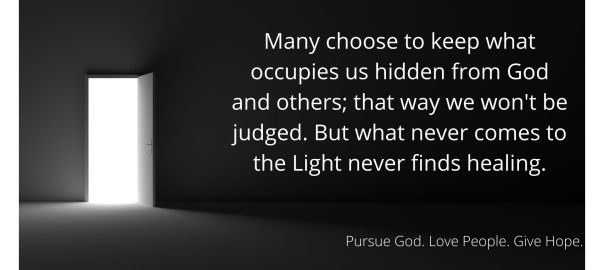
v. 19 This, then, is the judgment: The Light has come into the world, but people more willingly loved the darkness instead of the light for they were occupied with wickedness.

v. 20 For each person continually practicing evil despises the light and does not step into the light; otherwise, what they are occupied with is uncovered.

v. 21 But, everyone who keeps doing what is true steps into the light; that way, the deeds they are occupied with might be revealed for what they are, by the hand of  God.

v. 16 For God loved the world so much that He gave His one and only Son so that everyone who puts their faith in Him should not perish but instead have eternal life.

Some commentators feel that, beginning with this sentence, Jesus quits talking and John begins his comments on the meeting. There is no indication that Jesus has left off; he knows who he is and what he came to accomplish. Jesus is giving us the “establishing shot” of the Good News of the Kingdom. It does read easier as a Johannine aside.

John’s use of agape is his trademark word for what God the Father is doing through Jesus. He loves. That he loves the world, that is all the people of the earth, is news to the religious leaders who assume they are the only lovable ones. Do you ever think of yourself as “loveable?” God. Loves. You. Romans 8:32.

This passage captures the intimacy of the Triune God, the essence of God’s plan, the depth of his love, the reach of his provision, the power of His redemption and the severity of the enemy’s hold on man.

For God – 1 Thess 5:23, So loved – Romans 5:8, The world – 2 Cor 5:19, He gave – dozens of times in John’s Gospel, “the father sent me,” His one and only Son – Hebrews 1:2, whoever – Romans 5:6, believes in Him – 1 John 5:13, not perish – 2 Peter 3:9, have life – John 10:10, John 1:12.

v. 17 After all, God did not send His Son into the world to condemn the world but for the express purpose that the world could be saved through Him.

Every nation; not just the Jewish people. He came to revolutionize the world, one nation, one tribe, one tongue at a time.

While Jesus’ coming lays out a clear choice for salvation and restoration to all people, and those who refuse or ignore will be separated and judged, it is not for this judgment that Jesus came; it is for salvation, for love, for relationship for a lifetime.

Condemn may be better as judge, in order to fit the rest of Jesus’ argument. He didn’t come to bring judgment; he came to save.

God sent, as it God, the one who enters at the demand of another a new place of people. Apostello – God the Father sends (apostello) Jesus on mission.

v. 18 Whoever puts their faith in Him is not under judgment; but whoever has not put their faith in Him already lives under judgment for this very reason: they have not put their faith in the one and only Son of God.

An interesting aside: the dark isn’t bad when it conceals good deeds from the eyes of evil people who might pursue for harm. Keeping actions in the dark when those very actions might, if seen, bring harm; that is a time when we ask God to make them obscure.

This verse is a dividing line. Those who have light poured in, who have life; or those who keep their pursuits in the darn,

v. 19 This, then, is the judgment: The Light has come into the world, but people more willingly loved the darkness instead of the light for they were occupied with wickedness.

Occupied is the same word for works. Occupied might fit better since this verse is discussing what we keep on working on. If my works are the continual focus of darkness without ever seeking the light, then judgment is certain.

They are enamored with the light and the values it brings; but they hate the Light, the personality of God’s own Son. Could it be that those in darkness want what the light brings but only if they can manufacture it themselves? John 5:35 They loved, that is, they were enamored with, the light for a time, but rejected it in the end.

v. 20 For each person continually practicing evil despises the light and does not step into the light; otherwise, what they are occupied with is uncovered.

Evil in verse 19 is a harsher word than here in verse 20. Here, evil means fruitless or meaningless. If we occupy our lives with things worthless and that have no substance, we are despising light and hope to keep our practices under cover.

“practicing evil” as in the works of the individual that ignore God’s ways and truth.

v. 21 But, everyone who keeps doing what is true steps into the light; that way, the deeds they are occupied with might be revealed for what they are, by the hand of  God.

The word for doing in the context of evil and good is different. One means to keep practicing evil; the other could mean pursuing good.  “Do truth” means that our pursuits are based on the truth of God’s Word morally and of value to the Kingdom.

The deeds are what aligns with God’s ways and are empowered by his hand. When we do good in His name, He empowers it beyond our own capacities.

In the film industry, the establishing shot is the context builder. It establishes the person in context to location and tone as well as the time period and feel of the coming shots. They give sweeping, wide focus to what the main character will face.

Your life and mine is God’s writing his story into us and through us. Our testimony. Our relationship is in context with the Gospel of the Kingdom, the ultimate story.

Small Group Discussion:

  1. Do you have a favorite movie character that, if you could, you would become? Why?
  2. John 3:16 is the possibly the most famous verse in the Bible. When did you first see it? When did you first discover what it means to you? Or are you still trying to find out about it?
  3. Jesus gives everyone the same starting point in life according to v. 18. What does this say?
  4. What is God’s solution in these verses for us to know Him?
  5. Do you ever think of yourself as “loveable?” In light of John 3:16, how does God see you?
  6. What is going on in your life that you need God’s touch or provision for?