
Tag Archives: Easter

Pastor Rick’s Study Notes: Mark 15:42-16:8

Good Friday & Easter Sunday 2022

Pastor Rick’s Study Notes:

Mark 15:42-16:8

(PRT)

vv.15:42-43 And evening had already arrived, and now that it was the Preparation Day before the Sabbath, and Joseph of Arimathea who was a respectable member of the Jewish Council and was waiting patiently for the Kingdom of God, went boldly to Pilate and asked for the body of Jesus. vv. 44-45 This made Pilate wonder if Jesus was already dead, so he called the captain of the guard, asked him whether or not he had already died; then, learning from the captain that Jesus was dead, he gave Joseph the body. v. 46 And he brought a linen burial cloth he’d purchased and lowered Jesus from the Cross and wrapped him in the burial cloth. Then he laid him in a tomb which had been hewn out of the rock and then rolled a boulder against the entryway of the tomb. v. 47 Now, Mary Magdalene and Mary the mother of Joseph saw where he was laid.

vv. 16:1-2  And awhile past the Sabbath, Mary Magdalene, Mary the mother of James, and Salome bought spices and scented oils hoping to return and anoint Jesus. Then, very early as the sun was rising, they come to the tomb. vv. 3-4 And they talked among themselves: “Who will roll back the boulder away from the entryway of the tomb for us?” But when they looked up, they saw the boulder was indeed very large, but was rolled away. v. 5 And when the women entered the tomb, they saw a young man clothed in a white robe seated to the right and they were totally overwhelmed with amazement. v. 6-7 Then he said to them: “Do not be distressed! Jesus the Nazarene, the one you are looking for who was crucified? He is risen and no longer here. See! Here’s the place where they laid him. But, you need to go and announce and explain to his disciples and to Peter that he going on ahead into Galilee. That’s where you will see him, just like he explained it all to you.” v. 8 So they got out and ran from the tomb gripped and trembling with amazement they spoke to no one for they were afraid.

Study Notes:

vv. 42-43 And evening had already arrived, and now that it was the Preparation Day before the Sabbath, and Joseph of Arimathea who was a respectable member of the Jewish Council and was waiting patiently for the Kingdom of God, went boldly to Pilate and asked for the body of Jesus.

Joseph did the risky thing. He was respectable and known and “in the know.” Now he was a Jesus-lover. Now he has risked his reputation to do the honorable thing.

vv. 44-45 This made Pilate wonder if Jesus was already dead, so he called the captain of the guard, asked him whether or not he had already died; then, learning from the captain that Jesus was dead, he gave Joseph the body.

Even Pilate, who condemned Jesus to the Cross, wondered that Jesus had already died after only around 5-6 hours. Some would later use this “quick” notification of death as the reason that Jesus was “resurrected (e.g. that he was not really dead.) That has real problems. 1) the Centurion cohort killed him by nailing him to the cross and raising a spear through his side. 2) All the witnesses there saw him die. 3) Joseph brought him down dead from the cross. 4) The cohort of guards buried and sealed him. 5) Most importantly, each Christ-follower there went to his death with the same proclamation: Jesus is risen. There was nothing normal about Jesus’ death. A convicted man would last a while then would be flung into the group burial pile. No one mourns. No one lays claim. Ignored. Gone. For Jesus, Not in the group burial pile. Not ignored. Not mourned. Not long on the cross.

It’s almost as if Jesus saw “the day’s work completed” and moved on to complete the sacrifice by breathing his last. Tetelistai, last breath.

v. 46 And he brought a linen burial cloth he’d purchased and lowered Jesus from the Cross and wrapped him in the burial cloth. Then he laid him in a tomb which had been hewn out of the rock and then rolled a boulder against the entryway of the tomb.

He came prepared to risk it all. The cloth he brought him down with may have become the cloth he wrapped him in.  All that time and money Joseph invested in his own tomb, he gave up for the one who loved him,

v. 47 Now, Mary Magdalene and Mary the mother of Joseph saw where he was laid.

I’m so glad we have Mark 16:1-8. Otherwise, the Mary’s are left grieving. They followed Joseph to the tomb with a plan but had no clue what the Father planned. Remember, they heard the same clear teaching over the ministry of Jesus. I’m here to be taken by evil men, to die, to be buried, to conquer death, and to return to the seat of power and the seat of intercession.

vv. 16:1-2  And awhile past the Sabbath, Mary Magdalene, Mary the mother of James, and Salome bought spices and scented oils hoping to return and anoint Jesus. Then, very early as the sun was rising, they come to the tomb.

Keep the timeline in mind here. They saw Jesus taken in the dark of what we would call Thursday, but for the Jewish week, sundown begins the new day (evening and the morning). So Jesus is handed over to evil people (Friday), abused, tried, convicted and crucified (Friday). Died and quickly buried before sundown (Friday). In the grave all the Sabbath (our Saturday – or day two of his “Passion.”) That night, most likely, (Sunday – evening and morning is the day, right) the Mary’s shop and gather what they need for the early morning walk in the dark (Sunday.) Jesus risen (Sunday) just before the Mary’s return. Three days in the grave.

vv. 3-4 And they talked among themselves: “Who will roll back the boulder away from the entryway of the tomb for us?” But when they looked up, they saw the boulder was indeed very large, but was rolled away.

They chatted about their plan as the made their way in the dark toward the cliffside where Joseph had been preparing what he thought would be his own tomb. Salome looks at the Mary’s “but you know that stone will be a huge boulder.” And they turn the corner: “It is a huge boulder; but has already been moved!”

v. 5 And when the women entered the tomb, they saw a young man clothed in a white robe seated to the right and they were totally overwhelmed with amazement.

Amazed as in overwhelmed and all but falling over.

v. 6-7 Then he said to them: “Do not be distressed! Jesus the Nazarene, the one you are looking for who was crucified? He is risen and no longer here. See! Here’s the place where they laid him. But, you need to go and announce and explain to his disciples and to Peter that he going on ahead into Galilee. That’s where you will see him, just like he explained it all to you.”

I like to think angels have accents (like a New York downtown cabbie). “Wait you’se. Don’t blow a gasket! Jesus, you know, the Nazarene. (snaps fingers under nose) Hey. Pay attention here: the one you’re here looking for? He’s not hear. Nope. That’s his tomb, but he ain’t here. Now, here’s the plan. Go get the disciples (and make sure Peter gets this, too, right). Get to Galilee. He’ll meet you there. Hey. Weren’t you listening? It’s what He told you’se all along.”

v. 8 So they got out and ran from the tomb gripped and trembling with amazement they spoke to no one for they were afraid.

And the news was out. That’s a hard place to end the original Good News account. But in some ways, what if this is where it ended. They got the story, believed it, and went away processing it. Afraid to speak because they didn’t want to break the sense of amazement. Then Luke picks up the rest in Acts 1. The oldest manuscripts of Mark stop here. Later manuscripts add a verse or two to summarize the rest of the story or even expand on Jesus’ commissioning of the disciples. But these continuations are not in the style, vocabulary, or flow of Mark’s writing. They aren’t wrong and are read in the context of the other Gospels. Some say a scribe took liberties; others that the original ending was lost and someone replaced it the best they could; and others that the New Testament church culture filled in the gap. My take is, the gap is there to remind us we walk away from the salvation story amazed, and with a lifetime to live out the Gospel story. The Kingdom is coming all through the church age; breaking in, amazing us, showing us the evidence of the risen Lord.
Pastor Rick’s Passage Translation for Palm Sunday

Mark 15:20-41

(PRT)

v. 20 And while the soldiers humiliated and taunted him, they dressed him in his own clothes in place of the purple robe, and they led Jesus out so they could crucify him.

v. 21 Then they conscripted Simon from Cyrene, Alexander and Rufus’s father, as he passed by while visiting from the surrounding farmlands and they made him carry his cross.

v. 22 And they goaded him toward Golgotha – the name translated as the place of the skull.

v. 23 They gave him wine mixed with myrrh, but he did not take it;

v. 24 And once they had crucified him, they then divided his clothes by casting dice to see who would get what item.

v. 25 They crucified him at 9 in the morning;

v. 26 And the crime inscribed against him was this: The King of the Jews.

v. 27 They also crucified with him two thieves, one to his right and one to his left. (v. 28 And this fulfilled the Scripture that says: “He was numbered among the criminals.”)

v. 29-30 And those parading by disparaged and cursed him. They shook their heads and exclaimed: “See here! It’s the one who claimed to tear down the temple and build it back in three days! Save yourself! Come down from that cross!”

v. 31-32 In the same way, the chief priests scoffed among themselves along with the scribes: “He delivered others, but he can’t even save himself! The Messiah! The King of Israel! Let him come down from the Cross so we might see and believe!” And those being crucified with Him berated him, too.

v. 33-34 Then, at noon darkness covered the land until three in the afternoon. Jesus, at that hour, cried loudly: “’Eloi, eloi, lama sabachthani!’ (Which translates as: ‘My God, my God, why have your abandoned me?’”

v. 35 And some of those standing nearby heard Jesus and said, “Listen, he’s calling on Elijah!”

v. 36 Then someone again ran over and soaked a sponge in soured wine, put in on the end of a staff, and gave it to Jesus to drink, while saying: “Leave him alone and let’s see if Elijah comes to take him down!”

v. 37 Then, Jesus groaned aloud and breathed his last breath.

v. 38 At that moment, the curtain in the temple was ripped open from top to bottom into two pieces.

 v. 39 Also, the captain of the soldiers who was standing across from him, saw the moment Jesus breathed his last, exclaimed: “Without a doubt, this man was the son of God!”

v. 40-41 And there were also women watching from a distance, including Mary Magdalene, Mary (Little James’ and Joseph’s mother), and Salome; they were the ones who followed him when Jesus was in Galilee. They attended him along with many others who came up with him to Jerusalem.

A New Accord

Each time you and I take part in the celebration of Communion, each bite of broken bread and each sip of wine (or Welch’s), celebrates the new accord, or the New Covenant Jesus secured for us that first Easter weekend. He died, was buried in that death, and rose from the short-term tomb to end the enemy’s rule of death and chains. It is a totally new and unique way to relate to the Creator – no more animals on the altar or lists to get God’s favor.

His body broken, His blood spilled, to give us the grace gift of redemption and restoration!

Sunday’s Communion Celebration was extraordinary. The Father’s Presence met us as we met in small groups around the cup and loaf. The moment was both communion and cleansing.

It’s a celebration and His presence is near in our obedience (no, I don’t believe the bread and wine become the body and blood) – and as a part of our worship, we draw near to Jesus as He comes near to His kids.

You have been reconciled to God, not just to quit sinning or to adhere to a legal standard. You have been reconciled to fulfill the grand adventure of your calling to make your life one that invites your world to be reconciled to Jesus, too.

Join in the worship of the Redeemed with us Sunday!

The Earth Trembled and Darkness Fell

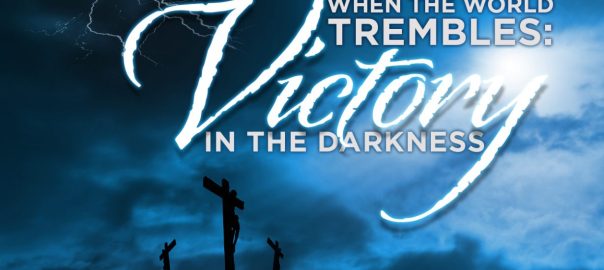
Today is Palm Sunday, the day in the Scriptures when Jesus entered the gates of Jerusalem to the shouts of praise from the people. This praise was short-lived as many of the same people were quick to reject Jesus just a few days later. When Jesus was taken into custody, he declared it was the “hour that darkness reigned.” And in the midst of those darkest moments, Jesus brought the greatest victory. And it’s often in our darkest times of sorrow, grief, loneliness, or broken relationships that God speaks to us of His love and grace – and invites us into that victory. That’s the Jesus we celebrate today!

Where:

26As they led Jesus away, a man named Simon, who was from Cyrene, happened to be coming in from the countryside. The soldiers seized him and put the cross on him and made him carry it behind Jesus. 27A large crowd trailed behind, including many grief-stricken women. 28But Jesus turned and said to them, “Daughters of Jerusalem, don’t weep for me, but weep for yourselves and for your children. 29For the days are coming when they will say, ‘Fortunate indeed are the women who are childless, the wombs that have not borne a child and the breasts that have never nursed.’ 30People will beg the mountains, ‘Fall on us,’ and plead with the hills, ‘Bury us.’ 31For if these things are done when the tree is green, what will happen when it is dry?

32Two others, both criminals, were led out to be executed with him. 33When they came to a place called The Skull, they nailed him to the cross. And the criminals were also crucified—one on his right and one on his left.

34Jesus said, “Father, forgive them, for they don’t know what they are doing.” And the soldiers gambled for his clothes by throwing dice.

35The crowd watched and the leaders scoffed. “He saved others,” they said, “let him save himself if he is really God’s Messiah, the Chosen One.” 36The soldiers mocked him, too, by offering him a drink of sour wine. 37They called out to him, “If you are the King of the Jews, save yourself!” 38A sign was fastened above him with these words: “This is the King of the Jews.”

39One of the criminals hanging beside him scoffed, “So you’re the Messiah, are you? Prove it by saving yourself—and us, too, while you’re at it!”

40But the other criminal protested, “Don’t you fear God even when you have been sentenced to die? 41We deserve to die for our crimes, but this man hasn’t done anything wrong.” 42Then he said, “Jesus, remember me when you come into your Kingdom.”

43And Jesus replied, “I assure you, today you will be with me in paradise.”

44By this time it was about noon, and darkness fell across the whole land until three o’clock. 45The light from the sun was gone. And suddenly, the curtain in the sanctuary of the Temple was torn down the middle. 46Then Jesus shouted, “Father, I entrust my spirit into your hands!” And with those words he breathed his last.

Getting There:

Each Gospel writer invests a lot of time focused on the week of Jesus’ Passion – the triumphal entry through the gates of Jerusalem, the final teachings, the initiation of Communion, the betrayal, arrest, abandonment, denial, the mock trials and marches through the night to the High Priest and the Temple, then to Pilate, to Herod, and back to Pilate before carrying his own machine of execution, the Cross, to the place of crucifixion.

Our passage begins as Jesus, following a third brutal beating, is weighted down with the beam of his cross to begins the march of toward what was named “the place of the Skull.” He was complete exhaustion from the all-night marches and the punishing treatment and Jesus falls under the weight of the wooden cross beam.

And in the crowds among the onlookers from all over the Mediterranean and mixed in with the women of Jerusalem, the Roman centurion conscripts someone to carry this wooden cross behind Jesus as he progressed toward the place of crucifixion. Two things to know here before we move forward:

  1. The man conscripted is named Simon and he’s from the Libyan city of Cyrene. But we do know his name and his two sons, Rufus and Alexander, from John’s account. And that means he is known by the churches who would read this Gospel – likely a Christian and perhaps even one of the early Christians who show up helping in mission work in the Mediterranean and help found the church in Antioch in Acts.
  2. Jesus was fully deity, but also fully human. And his human body was on the brink of exhaustion.

And today I want to teach on what Jesus had said early on in his own teaching :

  • John writes that Jesus explained about this plan to reconcile us to the Father, John 10:18 “No one takes it from me, but I lay it down of my own accord. I have authority to lay it down and authority to take it up again. This command I received from my Father.”

Jesus fully took the mission to completion of going to the Cross for the redemption of a world spinning out of control and restoration of a people who are called by His name.

  • After they finally voiced that Jesus is the Messiah, Jesus told his disciples in Matthew 16:21 that, “he must go to Jerusalem and suffer many things at the hands of the elders, the chief priests and the teachers of the law, and that he must be killed and on the third day be raised to life.”

And today, we focus on the Cross and what it represents to people all over the globe. When Jesus endured the punishment and death of the Cross, he fulfilled the mission of redemption and restoration. And in Luke’s account His words and actions declare what He secures for us from the Cross.

There:

  1. Even in the deepest of hurts, Jesus gives forgiveness.

After being nailed onto the Cross and dropped upright into the ground, the four soldiers who formed the security detail for this execution site threw dice for the seamless robe Jesus wore under his outer clothing. The centurion in charge had watched his squad of four divide up Jesus’s sandals, belt, outer robe and head cover. Now they callously wager for the inner robe, not even aware that what they did was prophesied 1000 years before. This was exactly what the Psalmist would prophesy “They divided my clothes and cast lots for my garment.” Psalm 22.

And with the pain of the nails driven into the wood through his hands and feet by the very guards who gambled before him, Jesus called out to the Father and he gave forgiveness.

The immediate forgiveness was for the centurions before him. And we see this fulfilled when the lead centurion later confesses the Jesus must be the son of God.

But that gift of forgiveness extends through the centuries to all who acknowledge that it was our rebellion, our sin, that led Jesus to the Cross. While we didn’t toss dice for His clothes, we risked our eternity by ignoring God’s offer of forgiveness.

That was the very forgiveness I was offered as a young teen – this free gift of forgiveness for being satisfied separated from the Father who created and loved me, this gift of mercy that wipe my guilt and sin away so I could know God and discover what He created me for.

2. Even from the scandal of the Cross, Jesus reigns.

Illustration: When our kids were growing up, I would take some time with each one and read with them (it made for some long nights.) One of the series of books was from a British author named C.S. Lewis.  If you’ve read his Chronicles of Narnia, you know that the first book is about four young children who travel by way of a magic wardrobe to the land of Narnia, and they become Kings and Queens of this mystical land with the help of the powerful lion, Aslan. More than once, Lewis asserts that Narnia is never quite right unless a human was in charge. As a Christian, Lewis is pointing to two essential truths from Scripture:

  • God has made you and me stewards over His very own creation. We have been given a position of enjoying, taking care of, and stewarding or managing the resources of our world.
    • Genesis reminds us of this in the Creation story. When he first created humankind, he put them in charge of the land and all that lived on it.
    • And in those first few chapters we see examples of how well we manage what God has given us when we are in relationship with Him; and how badly it goes when we go our own way and ignore the call to be His own. Illustration: During those years as our three kids were beginning to own their choices, I would tell them: if you choose wisely and make good choices in line with our values, it will go well with you, and you will have more control in your life.

Illustration: In the same way, as Narnia goes well when humans are in charge, our world goes well when we represent the Father as we manage the creation He has made.

  • But a second truth, and even more important is this. While we are in charge, we also are our best when we live and work in relationship to our Creator. When the Father is in charge of our lives, when we are in covenant with Him and live in relationship to Him, we work best.
    • We are empowered
    • We are creative
    • We are liberated – we find freedom to succeed.
  • You and I are our best when we place our lives in a relationship of surrender and obedience to the Father. When we do, we manage life well and fulfill what He has created us to pursue.

This is what is restored to you and to me because Jesus chose to go to the Cross. And as the crowd scoffed and ridiculed Jesus as he hung on the Cross, as they derided him and mocked him, he never quit being who He is: “King”.

In fact, the last nails that were driven into the cross were the ones that secured the sign that declared who was from the top of the Cross.

If an onlooker stumbled into this place of crucifixion:

  • First, his eyes were riveted to the brutally beaten and wounded body of Jesus.
  • But as quickly as possible, his eyes would escape the horror to discover who might deserve such brutality. And they would see this epigraphae or titulus as it was called.
  • It was likely drawn in big black letters over a white graphite smeared background so people could see it from the crowd.
  • Each Gospel writer gives what the eyewitnesses saw during the traumatizing and horrendous experience.  
  • Above the thorn-crowned head of Jesus declared to the crowds and through the ages, This is Jesus of Nazareth, King of the Jews.

Even in his most painful moment, when he was on the Cross, he still reigned.

3. Even in the darkest of moments, Jesus calls us.

One of the most frequently used words in the New Testament that relates to our relationship to Jesus is the word “called.” The Apostle Paul says “we are called to one hope when we are called.” Peter writes that we are “called out of darkness into the wonderful new light.”

All four Gospel accounts record that Jesus was crucified between two robbers, the greater humiliation that He was surrounded by sinners and hung on the very cross that Barabbas the leader of the band of thieves would have died on.  But only Luke records that one thief recognized Jesus for who He was – the sinless Savior.

  • What kind of faith this man must have had? Jesus was on a Cross and not a throne. He was not in a visible place to give or grant anything.
  • “Remember me, King Jesus” he says, “when you come into your Kingdom.” If anyone could be King, it would be you.
  • And this repentant thief received the call. “Today you’ll be there.” What you missed out in your life apart from me, you’ll experience.
  • And from the Cross, when darkness ruled, Jesus extended a call to this thief who rightly was being punished. And as his strength ebbed in his own body on his own place of execution, this former thief with a destiny for eternity apart from the Father and all things good, stepped into the beauty of the fulness of the Kingdom of Heaven. Because Jesus called him.

Now Where:

Why has the Cross become such a symbol of hope for us? For the Roman soldiers and rulers, it was a scandal to even mention a crucifixion at a gathering it was so low and reserved for the worst of society. For the Jews, to have a religious leader, much less a Savior, die on a cross was a scandal that declared unworthiness. But for you and for me, the Cross represents the historical act of Jesus that changed our lives.

  • He forgave. Scripture says that each of us has revolted in our lives. We have taken our lives for ourselves and left Jesus out of our plans. And we return by declaring no more – I belong to Jesus now. And he forgives.
  • He took our shame. Jesus’ death on the Cross was the world’s attempt to humiliate the Son of God. But he took the Cross and made it the place of deliverance and restoration. He called us. He saw our need and knew our name. And by saying yes to this gift of forgiveness and wholeness, we say yes to His calling. To fulfill what he created us to be as a people, as a church, and the gifted and called person you are. But it has to begin at the Cross.
  • When Jesus surrendered his Spirit and died, the Gospels say that the earth tremble and darkness, physical darkness fell over the city. And the curtain that kept people from God’s presence in the Temple was split from top to bottom In Jesus’ death, we are invited into His presence to experience His wholeness and forgiveness, and step into His call on our lives.
  • And it begins at the cross.

Greater the darkness; more visible the victory.

I know people who have gone through great tragedy and experienced dark days. Businesses fail. Homes are taken. Children (or spouses) stray. Partners betray. What felt secure evaporates in a brief moment. And dark times and deep questions often follow.

And you might ask, Why bring this up? Because we all face those dark nights of the soul.

How you and I as Christ-followers respond in the darkness, and especially how we take one step at a time toward God’s grace and purposes in that darkness, has a great impact on people. We give hope to others when we pursue King Jesus and keep loving and serving others when our days are dark.

When Jesus was arrested in the Garden of Gethsemane, he announced it as the hour “when the power of darkness reigns.” (Luke 22:53). And for the next three days, the darkness crescendoed around the city of Jerusalem and across the heavenlies.

And heaven’s greatest coup came in the deepest darkness. What was usurped for millennia by the Conniver in the Garden of Eden was reclaimed for good in the dark hours in the Garden of Gethsemane.

Jesus is acquainted with the darkness; He does His best work when people need hope and salvation. And that’s when He does His best work in and through you and me.

This week, Renovation Vineyard Church begin our journey through the dark days of Jesus’ Passion as we move through the hours just before Easter Sunday and His unmatched triumph over the enemy and the grave.

Trusting His Victory in the Darkness – Pastor Rick